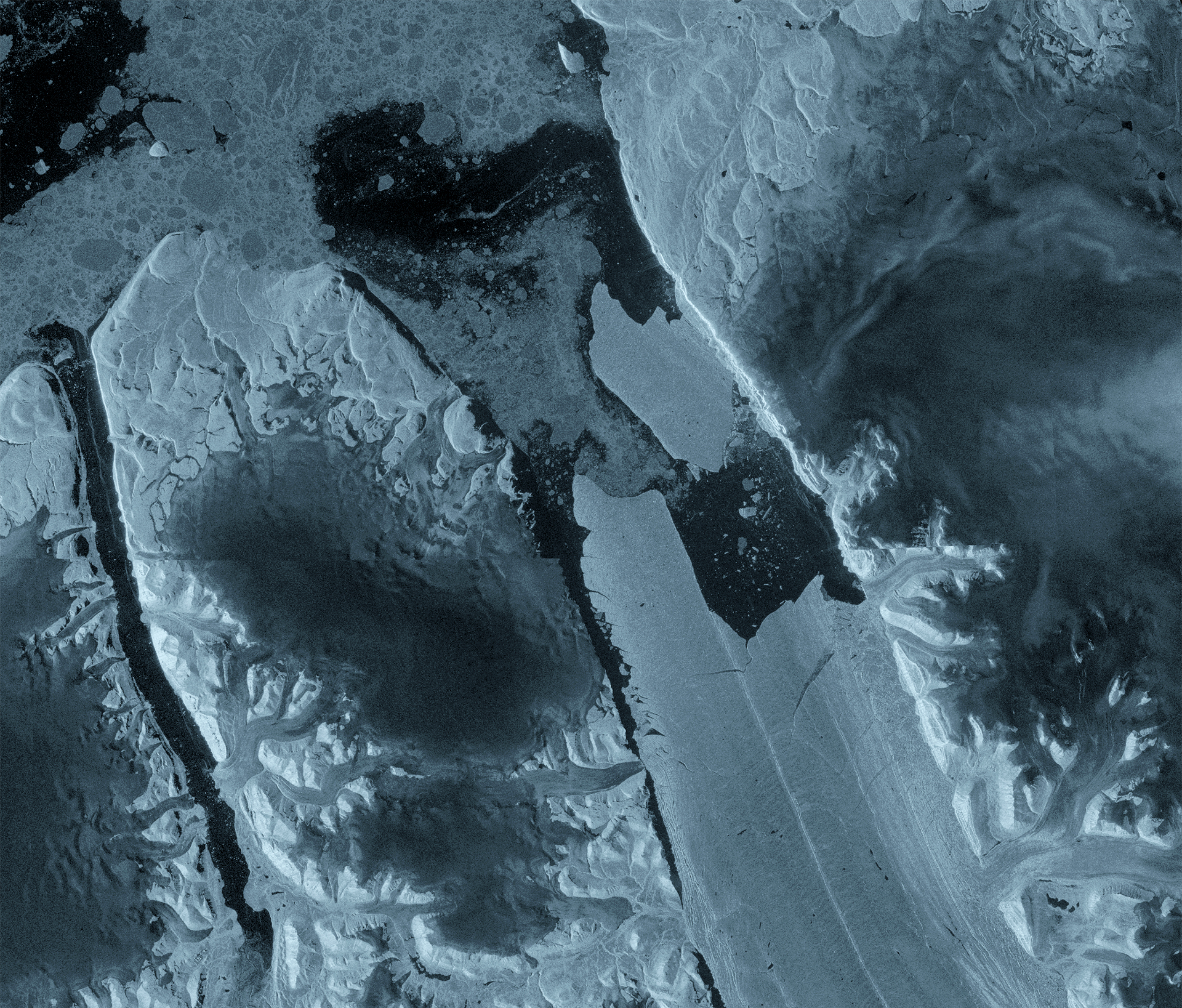
For a location so isolated that nearly no one will ever witness it from the surface, Petermann Glacier has yielded an exceptionally well-documented rupture. On 3 August 2026, European radar satellites captured notable degradation through the middle of its floating tongue. By 4 August, a 76-square-kilometre section had detached from the eastern side, transforming into an ice island.
The newly formed iceberg is approximately the size of Manhattan in terms of area and may have thicknesses reaching up to 150 metres, based on the European Space Agency’s report of the incident. This marks Petermann’s largest detachment of floating ice since 2012 and, according to ESA, the most significant calving occurrence in the Arctic since 2020.
While that represents a considerable chunk of ice, the typical city comparison requires clarification. “The size of Manhattan” pertains to surface area, not shape, mass, or the volume of ice above the water. The majority of a thick tabular iceberg is hidden beneath the surface.
The ultimate fracture took a day, but the failure process spanned years.
The clear before-and-after satellite images might lead one to perceive this as a swift, one-day occurrence. However, from a mechanical standpoint, it was the conclusion of a much more extended narrative.
Researchers, partially funded by ESA’s ARCTEX initiative, have been tracking Petermann since 2019. This team unites scientists from the universities of Ottawa, Stirling, Lancaster, and Leeds along with the Canadian Ice Service. Over time, they documented widening fractures and increased deformation in the floating tongue.
Radar interferometry obtained in April 2026 already indicated cracks and movement within the ice. On 3 August, Sentinel-1 imagery revealed deterioration along the centerline of the tongue. The eastern slab was separately identified the following day.
Thus, “broke free on 4 August” marks the moment the island became distinct. It does not imply that an intact ice sheet unexpectedly became unstable overnight. Glacier calving is frequently the dramatic final stage of a gradual structural transformation.
What exactly came apart?
Petermann is a marine-terminating glacier situated in northwest Greenland. Ice grounded on land flows down a wide channel toward Petermann Fjord. Close to the coast, it crosses the grounding line, loses contact with the bed, and extends over the sea as a floating tongue.
The released object originated from this floating section. It is referred to as a tabular iceberg due to its broad, comparatively flat shape resembling that of the ice tongue, as opposed to the pointed profile commonly imagined when one hears “iceberg.” In the Arctic, an exceptionally large, flat piece like this is also termed an ice island.
The image is radar, not a typical photograph. Sentinel-1 emits microwave energy toward the surface and gauges the return. This capability enables it to observe through clouds and during polar darkness—two significant advantages when examining a glacier near Greenland’s northern coast.
The two larger sections are possibilities, not certainties.
The new island might only be the initial major loss in this phase. ESA indicates that existing fractures delineate two additional sections projected to have surface areas of around 97 and 87 square kilometres. Either would exceed the piece that detached on 4 August.
These estimates shed light on the concerns highlighted in the headline, but “could detach” is not synonymous with “will detach soon.” A mapped rift does not constitute a countdown. Cracks can elongate, branch out, decelerate, or cease as stress distribution evolves. Tides flex the floating tongue, ice continues flowing from upstream, and contact with the fjord sides can redistribute forces.
In simpler terms, the fractures have already segmented the tongue into possible future slabs. Scientists can approximate their boundaries and areas, yet they cannot reliably assign a calving date to either one, and it would be hasty to add 97 and 87 square kilometres to the ice that has already been lost.
This iceberg will not directly elevate the sea level.
There is another boundary that should be carefully delineated. The 76-square-kilometre section was already buoyant before it was separated. Its weight was, hence, already displacing seawater. Detaching it, or observing it melt later, does not directly generate the sea-level impact associated with grounded land ice entering the ocean.
The National Snow and Ice Data Center succinctly clarifies the distinction: floating shelves do not directly influence sea level when they disintegrate, but their loss can have indirect consequences if the glaciers supplying them accelerate.
Floating tongues can function as a brake. Friction along their edges and contact with fjord walls or shallow structures produces resistance to the flow behind them. Removing enough of that resistance can result in grounded ice moving more rapidly toward the ocean, contributing to sea level rise.
It would still be overly simplistic to assert that every calving event disengages the brake by an equal measure. The support provided by different segments of an ice tongue varies. Researchers now need to assess Petermann’s response to this specific loss, particularly changes in flow speed and strain upstream of the newly formed front.