According to tradition, the Pythagoreans were heartbroken upon realizing that the diagonal of a unit square is an irrational number, as they held the belief that natural numbers were the fundamental components of the universe. It is even rumored that they killed the individual responsible for this revelation. The Pythagoreans were not alone in struggling with the existence of irrational numbers, or incommensurable numbers as referred to by the Greeks in their geometric studies. Using the example of a square’s diagonal, one cannot measure it with a predetermined fixed length. Thus, if the side of the square measures 1 cm, the diagonal cannot be quantified by any rational multiple of 1 cm lengths. It is impossible to measure one against the other. The mathematician recognized for providing a resolution to this conundrum was Eudoxus of Cnidus (c. 390–c. 340 BCE).
He was born in and died in Cnidus, located on the southwestern coast of Anatolia. None of his original writings have persisted; however, some fragments can be found in the Commentaries on the Phenomena of Aratus and Eudoxus attributed to Hipparchus (c. 190–c. 120 BCE), which is the only work by Hipparchus that has survived. From the writings of Diogenes Laertius (fl. third century CE), we learn that Eudoxus was an astronomer, mathematician, physician, and legislator. It should be noted that the scant information we possess about Eudoxus, similar to most early Greek mathematicians, comes from sources written many centuries after his time. He studied mathematics under Archytas (435/410–360/350 BCE), a Pythagorean, and medicine with Philiston of Locri (4th century BCE), both of whom resided in Magna Graecia, in Southern Italy. At the age of twenty-three, he ventured to Athens, attending the lectures of the Sophists for two months. Subsequently, he spent sixteen months in Egypt immersing himself in mathematics and astronomy. After further travels, he returned to Athens and is said to have taken on leadership of the Academy during Plato’s absence. Later, he returned to Cnidus and became involved in politics.
In the annals of science, Eudoxus is primarily recognized as the creator of the homocentric spheres model of the universe to elucidate the apparently erratic observed movement of the planets. This model was further refined by Callippus (c. 370–c. 300 BCE), one of his pupils, and later by Aristotle (384–322), who is also believed to have studied under Eudoxus at the Academy, when it coalesced with Aristotle’s cosmology to form the standard Greek model of the cosmos until it was supplanted by the deferent-epicycle model of Ptolemaeus (fl. 2nd century CE). Nonetheless, what concerns us here is Eudoxus’ impact on mathematics.
To uncover Eudoxus’ mathematical contributions, we must consult Euclid’s Elements, beginning with Book V, much of which is believed to be attributable to Eudoxus. In this section, he assists Greek mathematicians in circumventing the dilemma of irrational or incommensurable numbers. Early Greek mathematicians lacked concepts of lengths, areas, and volumes; they merely compared them. This led to two classic problems involving a straight edge and compass: squaring the circle and doubling the cube. The first seeks a square with an area equal to that of a given circle, while the second inquires about the cube that has double the volume of a specified cube.
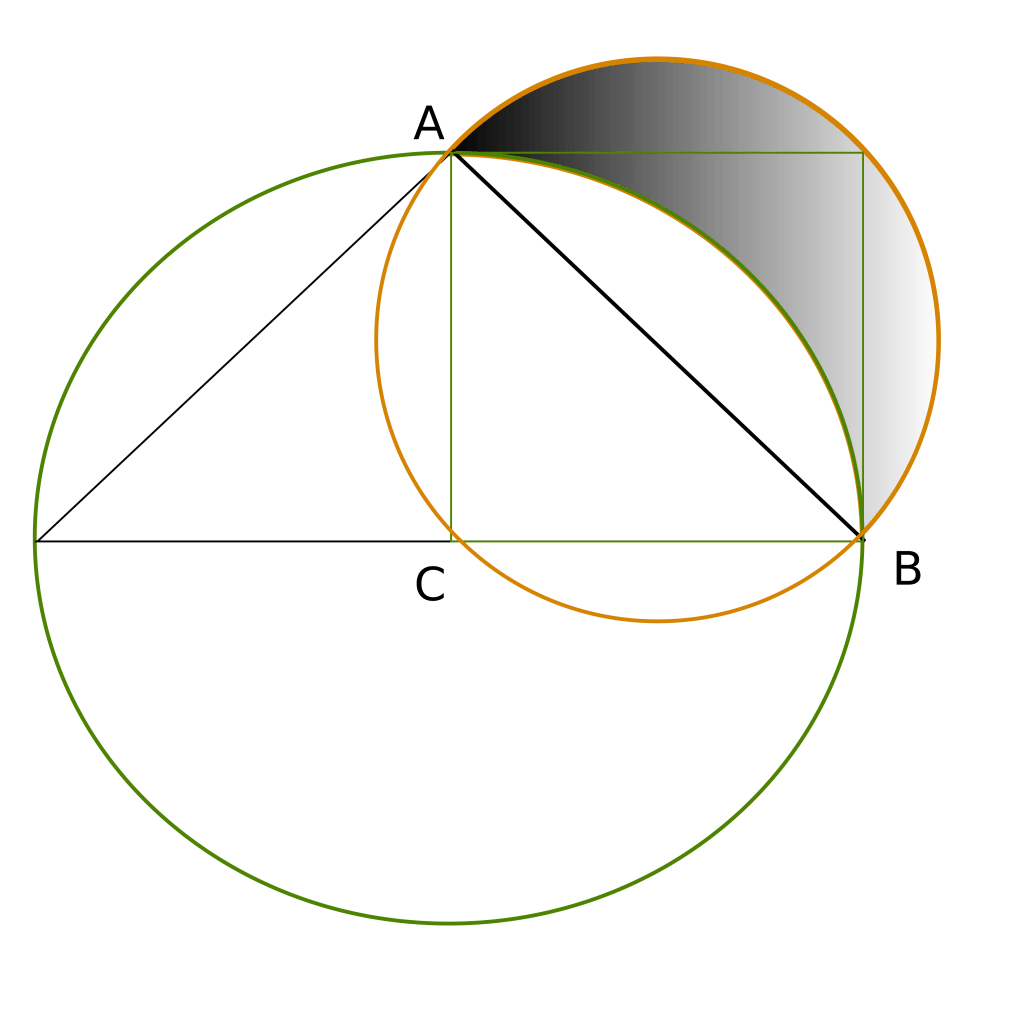
A pertinent illustration arises from the sole surviving fragment of a mathematician who lived a century prior to Eudoxus, Hippocrates of Chios (c. 470–c. 421), who was the first among five authors preceding Euclid to compose an Elements. In his quest to square the circle—a task at which he ultimately failed—Hippocrates succeeded in squaring the lune.
The Pythagoreans encountered irrational numbers while comparing line segments. Given two line segments a and b, with a > b, how many times can one portion b into a? Due to their fixation on natural numbers, the answer had to be expressed numerically. However, as previously mentioned, attempting to divide the side of a square by its diagonal yields an incommensurable result. Eudoxus addressed this issue by substituting numbers with magnitudes. Lines, areas, and volumes are said to possess a magnitude, a size that is not numerical. In Definition 5 of Book V of The Elements, we then find the following:
Magnitudes are claimed to be in the same ratio, the first to the second and the third to the fourth when, if any equimultiples whatever be taken of the first and third, and any equimultiples whatever of the second and fourth, the former equimultiples…