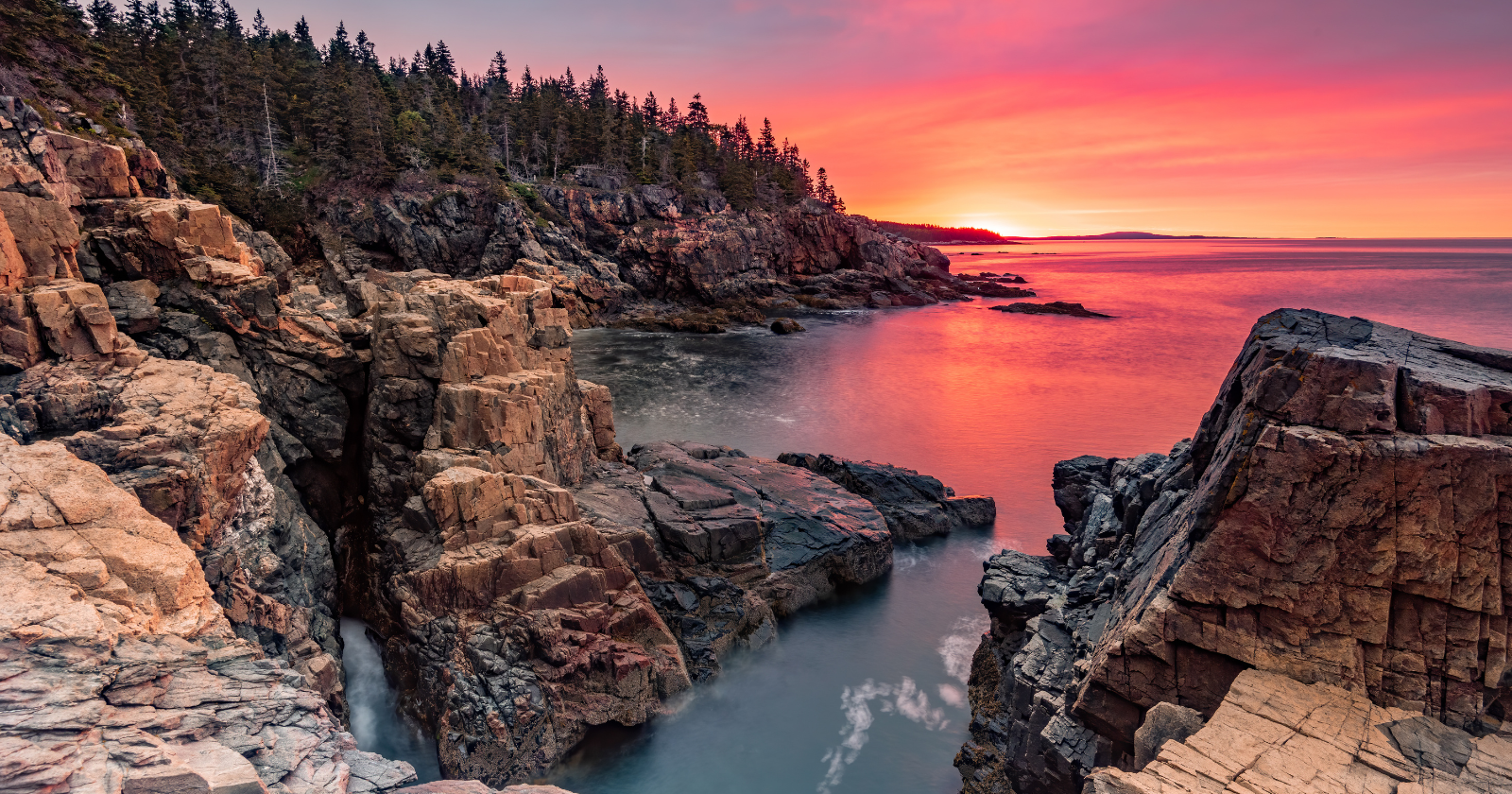
George Bucknam Dorr was precisely the type of American who typically does not end up financially destitute. Born in 1853 into a wealthy Boston family—his father’s side linked to a textile and merchant fortune, and his mother’s to Baring Brothers banking lineage—he epitomized a Harvard-and-Oxford educated gentleman scholar who never sought a profession, raised amidst Wordsworth and lengthy walks, the archetypal Brahmin who vacationed where fellow Brahmins vacationed.
From the age of fifteen, Mount Desert Island on the Maine coast became the family’s summer retreat. The family purchased beachfront property in Bar Harbor in 1868 and constructed a 30-room “cottage” named Old Farm. Decades later, it was here that Dorr purposefully spent down the family fortune to nearly nothing, achieving remarkable outcomes.
The island in peril
Dorr aimed to preserve a particular form of access. During the late 1800s, Mount Desert attracted an exclusive summer crowd of the extremely wealthy—Vanderbilts, Astors, Morgans, Fords—specifically for its unspoiled forests, granite summits, and rugged shoreline. However, two forces began to encroach: affluent landowners closing off picturesque areas for private estates, and, as Dorr specifically worried, the advent of the portable gasoline sawmill, allowing for the inexpensive logging of the island’s woodlands.
In 1901, at the behest of Harvard president Charles W. Eliot, Dorr co-founded the Hancock County Trustees of Public Reservations—a private entity with a singular mission: to protect Mount Desert land for the continuous enjoyment of the public. Eliot served as president; Dorr took on the role of executive officer, which effectively meant he was the person who made it happen.
Forty-three years of land acquisition
“Making it happen” involved acquiring the island piece by piece for the remainder of his life.
Dorr dedicated the following four decades to functioning as a solitary land-acquisition powerhouse: identifying crucial tracts, negotiating with property owners, and frequently reaching into his own finances when persuasion or public funding fell short. He purchased watersheds, mountain peaks, the spring at Sieur de Monts, coastlines—anything significant that became available. By 1913, the Trustees had secured 6,000 acres—much attributed to Dorr’s efforts and increasingly funded by his own resources.
Then, he headed to Washington to donate the land. In 1916, President Wilson accepted the collected lands as Sieur de Monts National Monument; in 1919, after Dorr’s tireless advocacy, it was designated Lafayette National Park—the first national park east of the Mississippi River and the first ever created entirely from donated private land rather than taken from the public domain. It was renamed Acadia in 1929. Dorr, appointed as its first superintendent, continued his work: acquiring, donating, and enlarging the park, often covering its initial costs himself.
The National Park Service summarizes his dedication succinctly: he committed 43 years of his life, energy, and family wealth to safeguarding the Acadian landscape. Throughout the park’s later years, he partnered with John D. Rockefeller Jr., whose wealth funded Acadia’s renowned carriage roads—but while Rockefeller was utilizing a mere fragment of his oil fortune, Dorr invested his entire inheritance.
Nothing remaining except the view
He expended it, draining his finances. Ultimately, Dorr had converted most of his inheritance into land that he had already transferred to public ownership. He never married and had no offspring; he transformed a Gilded Age fortune into a national park and retained essentially the deed to nothing.
He became blind in his later years yet remained on the island at Old Farm, living near poverty by his family’s standards, listening to readings and traversing the paths he faithfully preserved from memory. He passed away in 1944 at the age of 90. His residence and its grounds were, by prearrangement, integrated into the park following his death—the final parcel.
The assessment of his biographer resonates profoundly. Ronald Epp noted that Dorr’s true wealth was not merely the family inheritance, significant as that was in acquiring numerous parcels; those acquainted with him recognized that the park itself became his fortune. He achieved an extraordinary transformation for a wealthy individual: converting money into landscape, enduringly, and then relinquishing the money.
The magnitude of his bequest is more apparent now than it was then. Acadia attracts millions of visitors annually to its approximately 50,000 acres, ranking among the smallest yet most-visited parks within the system—each one unknowingly wandering through a gift. The Boston heir responsible for its creation concluded with nearly empty bank accounts and everything entrusted to the public: no heirs, no estate, no wealth left to tally. Only the island he.